

Most of us don't think about our lungs until something feels off: a staircase that seems steeper than it used to, a walk that leaves us winded sooner, or mornings when the first deep breath of the day just doesn't come as easily.
Some of that is simply time. But a surprising amount comes from things we can change: the air in our homes, how much we move, how we breathe, what we eat and how we sleep. This guide walks through each one, using guidance from public health agencies, so you can build a routine that supports your lungs for the decades ahead.
1. How your lungs change after 50
According to the American Lung Association, our lungs finish maturing at about age 20 to 25. After about age 35, it's normal for lung function to decline slowly over time.1 That happens for a few reasons:
- The diaphragm weakens. The main breathing muscle, which sits under your lungs, gets weaker with age, so each breath takes a bit more effort.
- Airways and air sacs lose elasticity. The tiny air sacs (alveoli) can lose their shape, and the airways can become a little baggier, which can trap some air.
- The ribcage gets stiffer. Bones can become thinner and change shape, leaving less room for the lungs to expand.
- Nerves in the airways become less sensitive, so the cough reflex that clears particles weakens.
None of this means your lungs stop doing their job. Healthy adults have plenty of reserve. But it does mean that the everyday factors in the rest of this guide matter more with each passing decade.
2. The air inside your home matters more than you think
The EPA estimates that Americans spend about 90% of their time indoors, and that indoor levels of some pollutants can be two to five times higher than typical outdoor levels.2 After 50, when many of us spend even more time at home, indoor air becomes the air we breathe most.
Common indoor air culprits
- Dust, pet dander and dust mites in carpets, bedding and upholstery.
- Smoke from fireplaces, wood stoves, candles and, above all, tobacco.
- Cooking fumes, especially from gas stoves without a vented range hood.
- Chemical vapors from cleaning sprays, air fresheners, paints and new furniture.
- Radon, a natural radioactive gas you can't see or smell. The EPA recommends testing every home; inexpensive kits are available at hardware stores.4
Simple fixes
- Change your HVAC filter on schedule. If your system supports it, the EPA notes that higher-efficiency filters (MERV 13 or higher) capture more fine particles.5
- Use a HEPA air purifier in the bedroom, where you spend a third of your life.
- Turn on the range hood every time you cook, and vent it outdoors if possible.
- Swap aerosol sprays for unscented, low-VOC cleaners.
- Open the windows for a few minutes a day when outdoor air quality is good. Check the daily Air Quality Index at AirNow.gov.
If you smoke, quitting is the single most important thing you can do for your lungs at any age. The CDC's free quitline, 1-800-QUIT-NOW, connects you to support in every state.6
3. Humidity, sleep and those heavy mornings
If your mornings start with a dry throat and a sluggish first breath, your bedroom air is a good place to look. Heating in winter and air conditioning in summer both pull moisture out of the air, and the EPA recommends keeping indoor relative humidity between 30% and 50%.3
Too dry, and the natural moisture that lines your nose and throat dries out overnight. Too humid (above 50%), and you invite dust mites and mold. A $10–15 hygrometer tells you exactly where you stand.
- If the air is dry, run a clean humidifier and rinse it as the manufacturer recommends.
- Wash sheets and pillowcases weekly in hot water to reduce dust mites.
- Keep pets off the bed if dander bothers you.
- If a stuffy nose turns you into a mouth breather at night, talk to your doctor about why. Breathing through the nose warms and humidifies the air.
Your bedroom is where you breathe for eight hours straight. Make it the cleanest air in the house.
4. Breathing exercises that help you breathe more efficiently
Breathing is automatic, but it's also trainable. The American Lung Association describes two simple techniques that help you use your lungs more efficiently.7
Pursed-lip breathing
- Relax your neck and shoulders.
- Breathe in slowly through your nose for about two counts.
- Purse your lips as if you were about to blow out a candle.
- Breathe out slowly through your lips for about four counts.
This slows your breathing and keeps the airways open longer, which helps you move more air with each breath. It's especially useful during activities that leave you winded, like climbing stairs.
Belly (diaphragmatic) breathing
- Sit or lie down comfortably, with one hand on your chest and the other on your belly.
- Breathe in through your nose and let your belly rise. The hand on your chest should barely move.
- Breathe out through pursed lips while gently tightening your belly muscles.
- Repeat for five to ten minutes.
Belly breathing trains the diaphragm, the muscle that does most of the work. Two or three short sessions a day is a realistic goal.
5. Movement: the most underrated lung habit
When you move, your heart and lungs work together to deliver oxygen to your muscles. Over time, regular activity makes that system more efficient. The CDC recommends that adults get at least 150 minutes of moderate-intensity activity per week, plus two days of muscle-strengthening activity.8
That's 30 minutes, five days a week, and it doesn't have to be a gym. Brisk walking, swimming, cycling, dancing and gardening all count. If you've been inactive, start with 10 minutes and add a few each week. Muscle strength matters too: stronger muscles need less oxygen to do the same work.
6. Foods for lung health
No single food is a lung cure, but your overall diet matters. In a European study that followed adults for about 10 years, people who ate more tomatoes and fruit, especially apples, showed a slower natural decline in lung function.9 A practical approach:
- Colorful fruits and vegetables every day: apples, tomatoes, berries, leafy greens, peppers.
- Omega-3 sources such as salmon, sardines, walnuts and flaxseed.
- Whole grains, beans and lentils for fiber.
- Spices like turmeric, ginger and black pepper. More on turmeric below.
- Water. Staying hydrated keeps the thin layer of mucus in your airways working properly.
- Go easy on ultra-processed foods and heavily salted snacks.
7. A 10-minute morning routine for easier mornings
Putting it all together, here's a simple routine many adults over 50 use to start the day:
- Minute 0: drink a full glass of room-temperature water.
- Minutes 1–3: open a window (if air quality is good) and do 10 rounds of belly breathing.
- Minutes 3–5: 10 rounds of pursed-lip breathing while standing.
- Minutes 5–10: light movement: shoulder rolls, gentle stretches, a short walk around the house.
- With breakfast: a colorful fruit, and any supplements you take with food.
8. Turmeric and black pepper: what the research says
Turmeric is the golden spice behind curry, and it has been used in Asian kitchens and traditional practices for centuries. Its most studied compounds are the curcuminoids, and curcumin in particular. Researchers have published thousands of papers on curcumin, much of it focused on its antioxidant properties and how it supports the body's normal response to everyday stress.10
It's important to be clear about what this research does and doesn't show. Curcumin is not a treatment for any lung condition, and it doesn't replace medicine. What it can be is one part of a healthy routine, alongside clean air, movement and good food.
The absorption problem
There's a well-known catch: curcumin on its own is poorly absorbed. Much of it is broken down and cleared before the body can use it.10 That's why sprinkling turmeric on your eggs does little, and why many cheap turmeric capsules disappoint.
The fix comes from another kitchen staple. In a human study published in Planta Medica in 1998, adding piperine, the active compound in black pepper, increased curcumin's bioavailability by up to 2,000%.11 Today, most well-made curcumin supplements include black pepper extract for exactly this reason.
Safety
The NIH's National Center for Complementary and Integrative Health notes that turmeric is generally considered safe in the amounts found in food, and that supplements may cause stomach upset in some people. There have also been rare reports of liver problems with turmeric supplements.12 Talk to your doctor before taking turmeric if you're pregnant or nursing, take blood thinners or diabetes medication, or have gallbladder or liver problems.
9. How to choose a turmeric supplement
If you decide a turmeric supplement makes sense for you, read the label for four things:
| Check | What to look for | Why it matters |
|---|---|---|
| Extract type | "Standardized to 95% curcuminoids" | Plain root powder contains only a small fraction of curcuminoids |
| Absorption | Black pepper extract (piperine / BioPerine®) | Up to 2,000% better bioavailability in a human study11 |
| Serving | Clear dose and directions | So you know exactly what you're taking |
| Manufacturing | Made in the USA, cGMP facility | Held to quality and labeling standards |
One formula designed around these points is LungVicks.
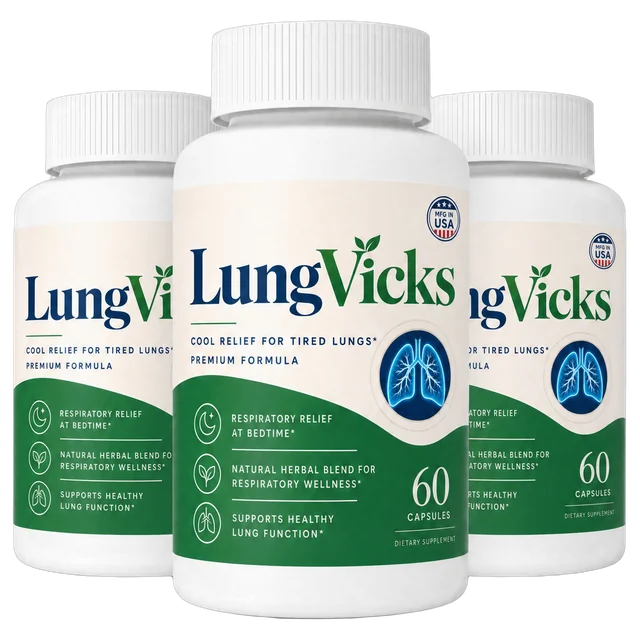
LungVicks: turmeric + BioPerine®
A daily capsule for adults who want comfortable, everyday support for their lungs as part of a healthy routine.*- Turmeric extract standardized to 95% curcuminoids
- BioPerine® black pepper extract for absorption
- One capsule, twice a day, with food
- Made in the USA
10. When to see a doctor
Everyday habits support healthy aging, but they're not a substitute for medical care. See a doctor promptly if you notice:
- Shortness of breath that's new, getting worse, or happens at rest
- A cough that lasts more than three weeks, or coughing up blood
- Wheezing, chest pain or chest tightness
- Unexplained weight loss or fatigue
- Frequent chest infections
Call 911 for severe trouble breathing or chest pain. And never stop or change a prescribed medication or inhaler without talking to your doctor first. Ask your doctor, too, about the vaccines recommended for your age.
Frequently asked questions
Do lungs get weaker with age?
According to the American Lung Association, lungs mature by about age 20 to 25. After about age 35 it is normal for lung function to decline gradually, as the diaphragm weakens and the airways and air sacs lose some elasticity.
What is the best humidity for sleeping?
The U.S. EPA recommends keeping indoor relative humidity between 30% and 50%. Above 50% encourages dust mites and mold.
What breathing exercises are good for the lungs?
The American Lung Association describes two simple techniques: pursed-lip breathing and belly (diaphragmatic) breathing. A few minutes a day can help you breathe more efficiently.
Is turmeric good for your lungs?
Turmeric's curcuminoids are widely studied for their antioxidant properties. Research does not show that turmeric treats any lung condition. It may be used as part of a healthy routine, ideally in a form combined with black pepper extract for absorption.
Why take turmeric with black pepper?
Curcumin on its own is poorly absorbed. A 1998 human study found that piperine, the active compound in black pepper, increased curcumin bioavailability by up to 2,000%.
Who should avoid turmeric supplements?
People who are pregnant or nursing, take blood thinners or diabetes medication, have gallbladder or liver problems, or have surgery scheduled should talk to a doctor first.
- American Lung Association. Lung Capacity and Aging.
- U.S. Environmental Protection Agency. The Inside Story: A Guide to Indoor Air Quality.
- U.S. Environmental Protection Agency. A Brief Guide to Mold, Moisture and Your Home.
- U.S. Environmental Protection Agency. A Citizen's Guide to Radon.
- U.S. Environmental Protection Agency. Guide to Air Cleaners in the Home.
- Centers for Disease Control and Prevention. Quit Smoking: 1-800-QUIT-NOW.
- American Lung Association. Breathing Exercises.
- Centers for Disease Control and Prevention. Adult Activity: An Overview (Physical Activity Guidelines).
- Garcia-Larsen V, et al. Dietary antioxidants and 10-year lung function decline in adults from the ECRHS survey. European Respiratory Journal. 2017;50(6):1602286.
- Hewlings SJ, Kalman DS. Curcumin: A Review of Its Effects on Human Health. Foods. 2017;6(10):92.
- Shoba G, et al. Influence of piperine on the pharmacokinetics of curcumin in animals and human volunteers. Planta Medica. 1998;64(4):353–356.
- National Center for Complementary and Integrative Health (NIH). Turmeric.