 Brightwell Today

If you're reading this, you've probably already tried the obvious stuff. Maybe you bought a humidifier. Maybe you sip honey-lemon tea before bed, or you've switched pillows twice. And yet most mornings still start the same way: a scratchy throat, a heavy first breath, and an hour or more before you feel like yourself.
That's frustrating, and it's also common. Most advice treats the symptoms of a heavy morning. The five reasons below are about the causes that tend to get overlooked, starting with the one almost everybody gets wrong.
- Your bedroom air is probably drier than you think, even with a humidifier.
- You may be breathing through your mouth all night.
- Your first hour is working against you.
- The air inside your home is often dustier than the air outside.
- If you take turmeric, your body may be absorbing very little of it.
In this article
Your bedroom air is drier than you think
"But I already have a humidifier."
Owning a humidifier and having the right humidity are two different things. Most people never measure. A small humidifier in a big room, a unit that runs dry at 2 a.m., or a furnace running all night can leave a bedroom at 20% to 25% humidity, which is drier than many deserts.
The EPA recommends keeping indoor humidity between 30% and 50%.1 Below that, the air pulls moisture from your throat and nose all night. Above it, you invite mold and dust mites, which create a different problem.
You're breathing through your mouth all night
"I don't snore, so that's not me."
You don't have to snore to be a mouth breather. If you wake up with a dry mouth, a sticky tongue or a sore throat that fades by mid-morning, there's a good chance you spent part of the night breathing through your mouth. A stuffy nose, sleeping on your back and dry air all make it more likely.
Your first hour is working against you
"I'm just not a morning person anymore."
Maybe. But look at what most of us do in the first hour: coffee before water, sitting still, shallow breathing while we scroll the news. After eight hours without fluids, that's a slow start by design.
The American Lung Association recommends two simple techniques to breathe more efficiently: belly breathing and pursed-lip breathing (in through the nose for two counts, out through pursed lips for four).3 And the CDC recommends 150 minutes of moderate activity a week for adults, which is just over 20 minutes a day.4
The air inside is often dustier than outside
"My house is clean."
Clean-looking and clean-air are not the same. Americans spend about 90% of their time indoors, and the EPA notes that concentrations of some pollutants indoors can be two to five times higher than outdoors.2 Pillows, pets on the bed and an HVAC filter that hasn't been changed since last winter all add up, and your bedroom is where you breathe for eight hours straight.
Your turmeric may not be absorbed
"I tried turmeric. It didn't do anything."
Lots of adults over 50 add turmeric to their routine. Its curcuminoids are among the most researched plant compounds, with much of the research focused on their antioxidant properties.7 But two things often go wrong.
First, many low-cost capsules contain plain turmeric root powder, which naturally contains only about 3% curcumin by weight.5 Second, curcumin on its own is poorly absorbed. In a human study published in Planta Medica, adding piperine from black pepper increased curcumin's bioavailability by up to 2,000%.6
That's the thinking behind LungVicks.
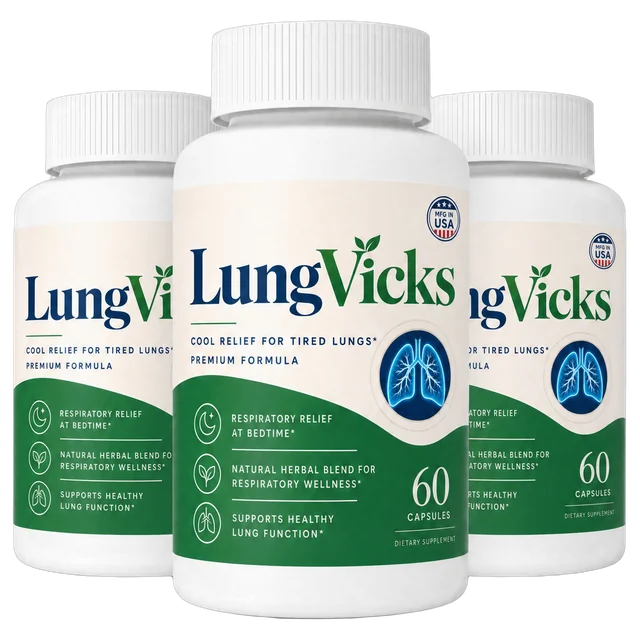
LungVicks: what's in the bottle*
- Turmeric extract standardized to 95% curcuminoids
- BioPerine® black pepper extract for absorption
- 60 capsules per bottle: one with breakfast, one with dinner (a 30-day supply)
- Made in the USA · sold only on the official site
How LungVicks compares
| LungVicks | Typical turmeric capsule | Turmeric in cooking | |
|---|---|---|---|
| Form of turmeric | Extract, 95% curcuminoids | Often plain root powder~3% curcumin | Spice powder~3% curcumin |
| Black pepper extract for absorption | ✓ BioPerine® | Sometimes | Only if you add pepper |
| Same amount every day | ✓ | ✓ | ✗ |
| Directions | 1 capsule with breakfast, 1 with dinner | Varies by brand | n/a |
Curcumin content of turmeric powder: Tayyem et al., 2006.5 Absorption: Shoba et al., 1998.6
What to realistically expect
If you fix the habits and add a supplement, here's a fair timeline. Results vary from person to person.
- Week 1The habits do the visible work: humidity, water, breathing. Don't expect to feel a supplement this early.
- Weeks 2–4Mornings may get steadier if you're consistent. Bad nights still happen; judge the trend, not one morning.
- Weeks 8–12A fair window to judge any supplement you take every day. Plan for about three months before you decide.
Frequently asked questions
How long until I notice anything?
Daily supplements work gradually, if you notice anything at all. Give a consistent routine 8 to 12 weeks before judging it. The free habits, like fixing bedroom humidity and drinking water on waking, are the part people tend to notice first.
I already use a humidifier. Is this still for me?
Possibly. Many people own a humidifier but never measure the room, so the humidity is still too low, or too high. Start with a $10–15 hygrometer and aim for 30% to 50%. A supplement is an addition to the habits, not a replacement for them.
Can I take LungVicks with my medication?
Check with your doctor first, especially if you take blood thinners or diabetes medication, are pregnant or nursing, or have gallbladder or liver problems. Never stop prescribed medication without medical advice.
Does LungVicks work?
LungVicks is a dietary supplement, not a medicine, so it isn't meant to work like a drug. Its formula, turmeric extract standardized to 95% curcuminoids with BioPerine black pepper extract, is made to support healthy lung function and the body's antioxidant defenses. We found no published clinical trial on the LungVicks formula itself; the research behind it is on its ingredients, curcumin and piperine. Results vary from person to person, and a fair trial takes 8 to 12 weeks of consistent use alongside healthy habits.
- U.S. Environmental Protection Agency. A Brief Guide to Mold, Moisture and Your Home.
- U.S. Environmental Protection Agency. The Inside Story: A Guide to Indoor Air Quality.
- American Lung Association. Breathing Exercises.
- Centers for Disease Control and Prevention. Adult Activity: An Overview.
- Tayyem RF, et al. Curcumin content of turmeric and curry powders. Nutrition and Cancer. 2006;55(2):126–131.
- Shoba G, et al. Influence of piperine on the pharmacokinetics of curcumin in animals and human volunteers. Planta Medica. 1998;64(4):353–356.
- Hewlings SJ, Kalman DS. Curcumin: A Review of Its Effects on Human Health. Foods. 2017;6(10):92.