

In this article
The alarm goes off. You sit up, reach for that first deep breath of the day, and it doesn't come as easily as it did ten years ago. Your throat feels like sandpaper. Your chest feels heavy. It isn't until the second cup of coffee and a slow shuffle around the kitchen that you start to feel like yourself again.
If that sounds familiar, you're in very large company. "Heavy mornings" are one of the most common complaints of people in their 50s, 60s and 70s, and they're often brushed off as just getting older.
Age is part of the story. But it's rarely the whole story. Most of what makes the first hour of the day so hard happens quietly overnight, in a room most of us never think twice about.
What really happens while you sleep
For seven or eight hours, you lie mostly still and breathe the same air, in the same room, with the door often closed. Several things work against you at once.
1. The air is drier than you think
Furnaces in winter and air conditioners in summer both pull moisture out of indoor air. The U.S. Environmental Protection Agency recommends keeping indoor relative humidity between 30% and 50%.1 Many bedrooms, especially in winter, sit well below that. Breathe dry air all night and the natural moisture that lines your nose and throat dries out, which is a big reason so many people wake up with a dry, scratchy throat.
2. You may be breathing through your mouth
The nose is the body's built-in humidifier: it warms, moistens and filters the air before it reaches your lungs. When a stuffy nose pushes you to breathe through your mouth at night, that filter is bypassed. You won't remember it, but your throat will.
3. The bedroom is a dust trap
Pillows, mattresses, carpets and curtains collect dust, dust mites and pet dander, and you spend the night with your face a few inches away from them. The EPA estimates that Americans spend about 90% of their time indoors, where some pollutants can reach two to five times typical outdoor levels.2
4. Natural changes with age
According to the American Lung Association, lungs finish maturing around age 20 to 25. After about age 35, lung function declines gradually as the diaphragm weakens and the airways lose some of their elasticity.3 That's normal, and healthy lungs have plenty of reserve, but it means the other factors on this list hit a little harder each decade.
"It isn't one big thing. It's a handful of small things that stack up overnight, and most of them are fixable."
The 10-minute routine more adults are trying
The good news is that heavy mornings respond well to small, consistent habits. Here's a simple routine built on guidance from the EPA, the CDC and the American Lung Association. It takes about ten minutes and doesn't require any equipment.
Minute 0: water before coffee
Keep a glass of water on the nightstand and drink it before you get up. After a night without fluids, it helps the throat and the natural moisture in your airways recover. Warm water with lemon works too.
Minutes 1–3: belly breathing by the window
Open a window if outdoor air quality is good (check AirNow.gov). Place one hand on your belly, breathe in slowly through your nose and let your belly rise, then breathe out slowly. Ten rounds. The American Lung Association recommends belly breathing to help strengthen the diaphragm.4
Minutes 3–5: pursed-lip breathing
Breathe in through your nose for two counts, then out through pursed lips, as if blowing out a candle, for four counts. It slows your breathing and keeps the airways open longer.4
Minutes 5–10: move a little
Shoulder rolls, arm circles, gentle side bends and a walk around the house. Movement gets your heart and lungs working together. The CDC recommends that adults build up to 150 minutes of moderate activity a week.5
With breakfast: color and support
Add a piece of fruit or some tomatoes. In a European study that followed adults for a decade, people who ate more tomatoes and fruit showed a slower natural decline in lung function.6 Breakfast is also when many people take their daily supplements.
And the night before
- Check the humidity. A $10–15 hygrometer tells you where your bedroom stands. If it's below 30%, run a clean humidifier.
- Wash bedding hot, weekly. It cuts down on dust mites.
- Run a HEPA purifier and keep pets off the bed if dander bothers you.
- Change your HVAC filter on schedule.
- Skip candles and aerosol sprays in the bedroom.
Where turmeric fits in
Among the supplements adults over 50 add to their breakfast routine, turmeric is one of the most popular. Its curcuminoids are among the most researched plant compounds, much of the research focusing on their antioxidant properties.7
There's a catch most people never hear about: curcumin on its own is poorly absorbed. In a human study published in Planta Medica, adding piperine, the active compound in black pepper, increased curcumin's bioavailability by up to 2,000%.8 That's why the label matters. Look for an extract standardized to 95% curcuminoids that includes black pepper extract.
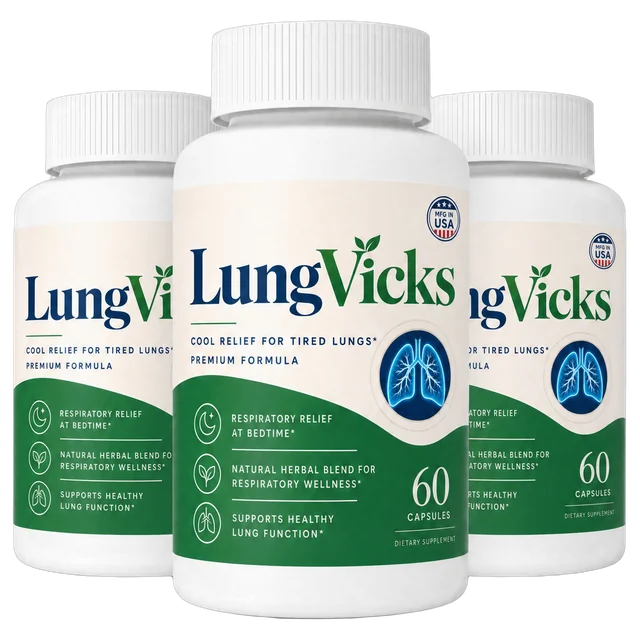
One formula built that way is LungVicks: turmeric extract standardized to 95% curcuminoids plus BioPerine® black pepper extract, one capsule twice a day, made in the USA. It's designed to support healthy lung function and the body's natural antioxidant defenses as part of a healthy routine.*
Frequently asked questions
Why do I wake up with a dry throat?
Common reasons include dry indoor air from heating or air conditioning, breathing through your mouth while you sleep, and not drinking enough fluids. Keeping bedroom humidity between 30% and 50% and staying hydrated can help. If it persists, talk to your doctor.
What is a good morning routine for adults over 50?
A simple routine: a glass of water on waking, a few minutes of belly breathing and pursed-lip breathing by an open window, light stretching, and a breakfast that includes fruit.
What is in LungVicks?
Turmeric extract standardized to 95% curcuminoids plus BioPerine® black pepper extract. One capsule twice a day with food. Made in the USA.
- U.S. Environmental Protection Agency. A Brief Guide to Mold, Moisture and Your Home.
- U.S. Environmental Protection Agency. The Inside Story: A Guide to Indoor Air Quality.
- American Lung Association. Lung Capacity and Aging.
- American Lung Association. Breathing Exercises.
- Centers for Disease Control and Prevention. Adult Activity: An Overview.
- Garcia-Larsen V, et al. Dietary antioxidants and 10-year lung function decline in adults from the ECRHS survey. European Respiratory Journal. 2017;50(6):1602286.
- Hewlings SJ, Kalman DS. Curcumin: A Review of Its Effects on Human Health. Foods. 2017;6(10):92.
- Shoba G, et al. Influence of piperine on the pharmacokinetics of curcumin in animals and human volunteers. Planta Medica. 1998;64(4):353–356.